
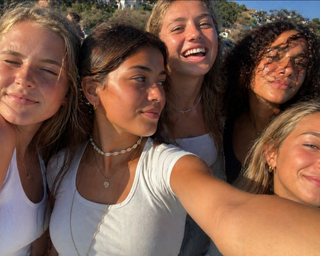
There's a version of the confidence conversation that stays very general. Believe in yourself. Embrace change. Take small steps. All true, none of it particularly useful.
The version we're more interested in is specific. It's about what happens when a teenage girl can walk into a room wearing something she actually chose, that actually fits, that actually reflects who she is. That's not a small thing.
What You Wear Affects How You Feel
Most people have felt it at some point: putting on something that fits well and feels right, and noticing the difference it makes. For teenagers, that effect is amplified.
Personal style and confidence are closely connected at this stage, because style is one of the earliest ways a young person communicates who they are to the world, and to themselves.
When what you're wearing reflects who you are and fits the way it should, you stop thinking about it. That's the point. Self-consciousness retreats, and you can focus on actually being in the room.
When the Options Don't Fit
For teenage girls whose size is not stocked in most girls' sections, that experience has often been out of reach. Not because their taste is different, but because what was available to them wasn't made with them in mind.
When the choice is between something that technically works and something that actually feels like yours, that compromise lands harder than it looks.
Style isn't shallow. Teen self-confidence and self-expression are genuinely connected. When the tools for that self-expression are limited by what exists in your size, participation in the ordinary rituals of teenage fashion, getting ready with friends, choosing something for an event, and feeling like yourself on a regular Tuesday becomes harder than it should be.
Design That Actually Considers Her
This thinking sits behind every decision we make at Maévie.
Building confidence in teens isn't something you do with a campaign. It's something you do by making things that actually work for them, trend-led, considered in design, and built around a teenage girl's life rather than retrofitted to her size.
The colourways, the silhouettes, the details. These things matter. Not because fashion is everything, but because having access to it, being included rather than adjacent, is part of what it means to feel like yourself during years when that's already a complicated thing to figure out.
That's what we're making Maévie for.
FAQ: Style, Confidence and Self-Expression
Q Is there a real connection between what you wear and how confident you feel?
A Yes, and it's more direct than it might sound. When what you're wearing fits well, reflects your taste, and feels intentional, you tend to stop thinking about it, which frees you up to actually be present. For teenagers, especially, where self-consciousness is already high, and identity is actively forming, that shift matters. Style is one of the first tools young people have for communicating who they are.
Q Why does it feel harder to find clothes and shoes in a size 9 or above as a teen?
A Because the fashion industry hasn't historically designed for it. Children's ranges stop at a certain point; adult ranges pick up from there but are styled and proportioned for adult women, not teenagers. The gap, older sizing, younger aesthetic, is where many teenage girls shopping in a size 9 or above find themselves. It's not a size problem. It's a design problem.
Q How can a parent support their teenager's sense of style without it becoming about appearance?
A By keeping the focus on choice and self-expression rather than outcome. 'You get to decide what feels like you' is a very different conversation from 'this looks good on you.' Making space for a teenager to experiment, change her mind, and develop her own taste, without it being linked to how she looks, is where the real confidence work happens.
Q Does teen fashion have to follow trends to feel relevant?
A No. What matters is that it feels like a genuine choice. For some teens, that means being right on trend. For others, it means finding a consistent personal aesthetic that sits slightly outside what everyone else is doing. Both are valid. The goal is that she's wearing what she actually chose, not what was the only thing available in her size.
Q At what age do teenagers start developing their own personal style?
A It varies, but the early teens, roughly 12 to 15, is typically when peer influence peaks and personal style starts becoming a conscious way of navigating identity. That doesn't mean it's fixed. Most people shift significantly through their teens and into their twenties. What matters during that period is having enough access to options that the exploration feels open rather than constrained.
Q What makes Maévie different from other fashion brands for teens?
A Most brands weren't designed for teenage girls whose size is not stocked in most girls' sections; they just happen to carry some styles that work. Maévie starts from the other end: designed specifically for that audience, with the trends, proportions, and design details that reflect a teenage girl's life. It's not an afterthought or an accommodation. It's the whole point.