
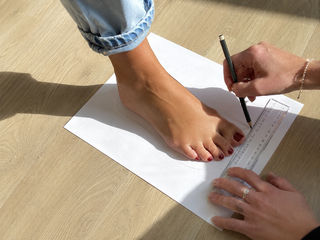
You found a shoe you love. You check the sizes. And then you realise you are not completely sure what size you actually are, because the last time someone measured your feet properly, you were probably about eight.
This matters more when you are shopping in a UK size 9 (EU 43) or above. When the range of available options is already narrow, buying the wrong size means fewer chances to exchange or replace. Getting the measurement right at the start is the most practical thing you can do before shopping online.
Here is the method. Four things, all in your house. Five minutes. The same method is used by Nike and Clarks in their own guides.
What you need
A piece of A4 paper, a pen or pencil, a ruler or tape measure, and, if easier for you, a wall or skirting board to stand against. Do this in the afternoon, feet swell slightly during the day and are at their largest by evening. Measuring in the morning and then wearing shoes all day is how you end up with shoes that feel fine at 9 am and tight by 3 pm.
The five steps
Step 1. Place the paper on a hard, flat floor. Tape it down if it moves.
Step 2. Stand with your full weight on the foot you are measuring, heel pressed down. No socks.
Step 3. Mark the tip of your longest toe with the pen held vertically, not angled. For most people, the longest toe is the big toe, but for some it is the second toe. Mark whichever reaches furthest.
Step 4. Measure from the back of your foot to the mark (the longest toe) in centimetres. Write it down.
Step 5. Repeat for the other foot. Most people have one foot slightly larger. Always use the larger measurement.
What your measurement means in shoe sizes
Match your centimetre measurement to the table below. These figures come from Maévie's own manufacturing specification, EU is the master system, UK and US are conversions.
| Foot length | EU | UK | US (women's) |
|---|---|---|---|
| 250.5mm / 25.1cm | EU 39 | UK 6 | US 7 |
| 257.0mm / 25.7cm | EU 40 | UK 6.5 | US 7.5 |
| 263.5mm / 26.4cm | EU 41 | UK 7 | US 8 |
| 270.0mm / 27.0cm | EU 42 | UK 8 | US 9 |
| 276.5mm / 27.7cm | EU 43 | UK 9 | US 10 |
| 283.0mm / 28.3cm | EU 44 | UK 10 | US 11 |
| 289.5mm / 28.9cm | EU 45 | UK 11 | US 12 |
| 296.0mm / 29.6cm | EU 46 | UK 11.5 | US 12.5 |
| 302.5mm / 30.3cm | EU 47 | UK 12 | US 13 |
The highlighted rows are where most brands stop, above UK 8, shoes designed for a teenage life are rare. If your measurement falls between two sizes, always go up.
Measure every six months during the teen years
Teen feet can go up half a size or more between one school year and the next. A measurement accurate in September may not be right by April. Measuring at the end of summer and the end of winter keeps you current. This is especially worth doing when shopping in a UK size 9 or above, the combination of rapid growth and a narrower range of available options means getting the size right matters more, not less.
For the complete size conversion table, see the UK shoe size guide for teenage girls. For more on why certain sizes are harder to find than others, see our post on why teen shoe sizes stop at UK 8.
FAQ
Q How do I measure my shoe size at home?
A Place a piece of A4 paper on a hard floor. Stand, full weight on the foot. Mark the tip of your longest toe with a pen held vertically. Trace around your foot. Measure from the heel to the mark in centimetres. Use the larger of your two feet. Do this in the afternoon when feet are at their largest.
Q Where can I find shoes for a teenage girl in bigger sizes in the UK?
A Most brands stop at UK 7 or 8, which means anyone shopping in a size 9 (EU 43) or above regularly finds the page ends before their size. Maévie was built specifically for that gap: footwear designed for a teenage life, starting at the sizes most brands stop carrying.
Q What is Maévie, and why is it different from other shoe brands for teens?
A Maévie is a footwear brand built specifically for teenage girls and young women whose size is not stocked in most brands. Not adult shoes that happen to come in larger sizes, footwear designed for a teenage life, with the silhouettes, colourways, and details that reflect what teens are actually wearing. The brand starts where the options stop.
Q How often should I measure my shoe size as a teenager?
A Every six months during the teenage years. Feet can change by half a size or more between school years. Measure at the end of summer and the end of winter to stay accurate. This is particularly important when shopping in sizes that have limited availability.