
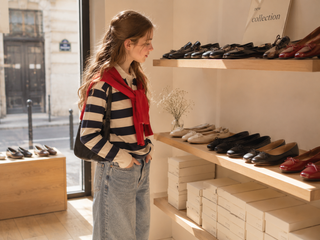
If you wear a UK size 9, 10 or above as a teenager (EU 43 and above), you already know this moment. You find the pair. You check the sizes. The page ends at an 8. Sometimes 8.5. Occasionally, a 9 exists, but in a colourway nobody wanted or a style designed for someone twenty years older.
This is not an accident. It is a stocking decision that has been made consistently across the high street for decades, and it affects a significant number of teenage girls, young women (and also older women) at exactly the age when personal style is becoming something that matters.
Two separate things that get confused
There are actually two different thresholds worth understanding, because they create two different problems.
The first is where children's sizing ends. In the UK system, children's sizes run from infant size 0 upward and end around UK size 5 to 6. At that point, adult sizing restarts from UK 1. This transition happens for many girls somewhere between the ages of 11 and 14, but feet continue growing well past that point, often reaching a UK 8, 9 or 10 before growth stabilises.
The second threshold is where most brands actually stop stocking shoes: UK 8, sometimes 8.5. This is a retailer's decision. It is not always a manufacturing constraint or a sizing system boundary. It is a commercial choice about which sizes to order and stock, and it is the one that your customer actually hits when she is shopping.
Understanding the difference matters. The children's sizing threshold is a structural feature of how the market is organised. The UK 8 wall is something retailers have decided. Which means it can be changed.
Why retailers stop at UK 8
The footwear industry organises itself around commercial volume. The majority of teen girls shopping wear sizes between UK 3 and UK 7. UK 8 and above represents a smaller proportion of that customer group, and historically, the commercial logic has been to focus stocking on the sizes that sell in the highest volume.
What this calculation does not account for is the customer who hits the wall. The girl who is a UK 8 does not stop wanting shoes. She stops finding them where she expects to. She moves to the adult section, where the sizes exist but the shoes were designed for someone a decade older, different proportions, different styling, different colourways. She finds a workaround. She builds a mental map of which brands happen to work. She manages.
That managing should not have been necessary.
What the adult section does not do
Adult women's shoes are designed for adult women. The lasts, the internal moulds that shape each shoe, are built for feet that have finished growing. The styling reflects what adult women want to buy. The heel heights, toe box shapes, colourways and silhouettes all reflect an adult wardrobe, not a teenage one.
Girls shopping at a UK 8 / EU 42 have become very good at working around this. They know which brands happen to run in styles they can actually wear. They have a mental map of where to look and where not to bother. That resourcefulness was not their choice. It is the result of a gap nobody had filled.
And if you wear a UK 9 or above, you already know it feels like a treasure hunt in store. Most of the time, you end up shopping online, and even there, the results skew heavily toward adult women rather than teenagers or young women. The size exists. The shoe designed for your life largely does not.
What is changing
Brands designed specifically for teenage girls whose size is not stocked, not adult shoes in larger sizes, but footwear built around a teenage life, are starting to exist where they did not before. Maévie is one of them. The silhouettes are current. The sizing starts where teen feet actually are. The styling reflects teenage wardrobes, not adult ones.
The UK 8 wall is a commercial decision. Commercial decisions change when brands decide to serve the customer who was being ignored. That is exactly what this brand was built to do.
For the complete size conversion table and measurement guide, see the shoe sizes for teenage girls in bigger sizes. For what shoe shopping actually feels like when your size is not stocked, see what it is actually like shoe shopping when your size is not stocked.
FAQ
Q Why do most brands stop at UK 8 for teenage girls?
A It is a commercial stocking decision, not a manufacturing limit. Retailers order the sizes that sell in the highest volume, and UK sizes 8 and above represent a smaller proportion of the customer base. The result is that teenage girls whose size is not stocked are pushed into the adult section, which was not designed for them.
Q Why is it so hard to find shoes in my size as a teenager?
A Because no brand has specifically been designed for it. Shoes in larger sizes exist, but they were built for adult women, the proportions, the styling, the colourways. Girls shopping in sizes 8 or above (EU 42 and above) are left in adult sections that were not made with them in mind. That gap is exactly what Maévie is built to close.
Q What is Maévie, and why is it different from other shoe brands for teens?
A Maévie is a footwear brand built specifically for teenage girls and young women whose size is not stocked in most brands. Not adult shoes that happen to come in larger sizes, but footwear designed for a teenage life, with the silhouettes, colourways, and details that reflect what teens are actually wearing. The brand starts where the options stop.
Q Do brands carry shoes for teenage girls and young women who need bigger sizes?
A Some carry larger sizes, but most were not designed with teenage girls and young women in mind. You are usually working out which brands happen to fit rather than shopping somewhere that was built for you. Footwear is the category where the options run out fastest. UK 8 / EU 42 is usually where most brands stop, and above that, the styles designed for a teenage life almost completely disappear.
Shoe sizes: UK, EU and US explained
Q What shoe sizes does Maévie offer?
A Maévie shoes are available in UK 6–12, which is EU 39–47 and US 7–13. If you fall between sizes, always go up. This is from our factory manufacturing specification; see the full conversion table on our size guide.
Q What is a UK 9 in EU and US sizes?
A UK 9 is EU 43 and US 10. Foot length approximately 276.5mm.
Q What is a UK 10 in EU and US sizes?
A UK 10 is EU 44 and US 11. Foot length approximately 283.0mm.
Q What is a UK 11 in EU and US sizes?
A UK 11 is EU 45 and US 12. Foot length approximately 289.5mm.
Q What is a UK 12 in EU and US sizes?
A UK 12 is EU 47 and US 13. Foot length approximately 302.5mm.