
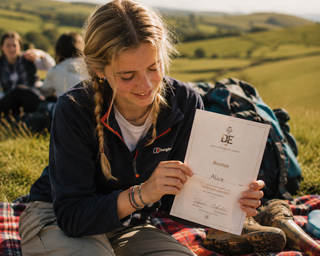
This year, the Duke of Edinburgh's Award turns 70. In May 2026, 9,000 Gold Award holders were welcomed to Buckingham Palace, teenagers and young people who completed something genuinely difficult, at their own pace, by their own design.
We have been thinking about why the DofE matters to us specifically, not in the general sense that outdoor activity is good for young people, but in the specific sense that the kind of confidence it builds is different from the kind that gets talked about most.
Performed confidence versus earned confidence
There is a version of the confidence conversation that focuses on how you look. Whether your outfit communicates certainty. This is not, nothing. We believe that what you wear and how it fits is connected to how you feel in a room, which is part of why Maévie exists.
But there is another kind of confidence that comes from having done something hard and knowing that you did it. Not performing it. Actually doing it, planning a route, carrying your weight, navigating a problem that was not solved by anyone else for you. That kind of confidence is DofE. It exists entirely outside what any clothing brand can give you. That is part of why we love it.
What the award involves
Three levels: Bronze for those aged 14 and above, Silver for 15 and above, Gold for 16 and above. Each involves a physical activity, a skill, and volunteering, plus an expedition. Gold also includes a residential project. The structure is flexible; you choose your own activities, your own causes, your own pace. Non-competitive. Self-directed. Personal development measured against your own goals, not anyone else's.
Why it matters particularly for girls
Research consistently shows that self-confidence in girls drops most sharply between 12 and 16, more than for boys of the same age, more than at any other point in a woman's life. DofE cuts across several of the causes directly. The expedition puts girls in outdoor environments where physical capability matters and aesthetic judgment does not. The skill and volunteering build a sense of contribution that has nothing to do with appearance.
For teenage girls who regularly find their size is not stocked, there is something quietly significant about an achievement framework where the size of your shoes has no bearing on what you can do. The girls who complete their DofE carry their rucksacks in whatever size they are. The badge belongs to the same person.
If you are thinking about DofE, the official site is the best starting point. Bronze starts at 14. For more on confidence and style, see our post on why what you wear matters more than you think.
FAQs
Q What is the Duke of Edinburgh Award, and who can do it?
A A voluntary, non-competitive programme open to young people aged 14 to 24. Three levels, Bronze, Silver, and Gold, involve physical activity, a skill, volunteering, and an expedition. Available in over 100 countries and recognised by universities and employers as evidence of genuine personal development.
Q Why is it so hard to find shoes in my size as a teenager or young woman?
A. Because no brand has specifically been designed for it. Most brands stop at UK 7 or 8. Above that, shoes exist, but they were built for adult women, with different styling and colourways. Girls shopping in a size UK 9 (EU 43) or above are left with options that were not made with them in mind. That gap is exactly what Maévie is built to close.
Q What is Maévie, and why is it different from other shoe brands?
A Maévie is a footwear brand built specifically for teenage girls and young women whose size is not stocked in most brands. Not adult shoes that happen to come in larger sizes, but footwear designed for a teenage life, with the silhouettes, colourways, and details that reflect what they are actually wearing. The brand starts where the options stop.
Q Does DofE look good on a university application?
A Yes, particularly Gold. Universities and employers consistently recognise the award as evidence of self-direction, resilience and the ability to complete something challenging over a sustained period. It cannot be gamed, only done.