
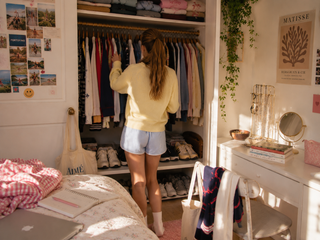
There is a specific kind of frustration that comes from scrolling through hundreds of outfit ideas and feeling further from knowing what you actually like than when you started. Everything looks intentional. Everything looks like someone else's version of a style. None of it feels like it belongs to you.
Building a personal aesthetic is not about finding the right Pinterest board. It is about working out who you are when you are not trying to be anything in particular, and then finding the clothes and shoes that reflect that person rather than perform a version of her.
Start with what you already reach for
Before you buy anything, save anything or decide anything, pay attention to what you already wear when nobody is watching. The jumper you put on first without thinking. The shoes you always reach for when you are in a hurry. The colour that appears three times in your wardrobe without you having planned it. These are your actual preferences, not your aspirational ones. Build from those.
An aesthetic is not a category
Cottagecore. Dark academia. Clean girl. These labels describe a cluster of references, not a person. The reason most aesthetic categories eventually feel wrong is that they were designed to be comprehensive, and no real person is a complete fit for a category someone else defined. Your aesthetic is the consistent logic that runs through your choices when you are being yourself. The goal is to understand your own logic well enough to apply it consistently, even when trends shift.
The shoe question is the whole question
Shoes are the element of an outfit that most clearly signals whether a look was chosen or assembled. Two people can wear the same outfit and look completely different depending on the shoes, not because one is more stylish, but because the shoes either confirm the logic of the rest of the outfit or contradict it.
For girls shopping in a UK size 9 ( EU 43) or above, this question has an extra layer. The shoe you would choose is almost always missing at that size on the high street or even online. The aesthetic you are building gets constrained not by your taste but by what exists for you. That is the gap Maévie was built to close, footwear that starts from your life, not from an adult wardrobe called teenage.
Build slowly and deliberately
A personal aesthetic is built gradually through choices that each reflect the same underlying logic. One piece at a time, each held against the question: Does this fit how I actually get dressed, or how I imagine getting dressed? That difference is the difference between a wardrobe you use and one you curate for an imaginary version of yourself.
For more on current shoe styles, see our post on stylish shoes for teenage girls shopping in size 9 and above.
FAQs
Q How do I find my personal aesthetic as a teenager or young woman?
A Start with what you already reach for rather than what you aspire to wear. The clothes and shoes you grab without thinking are your actual preferences. Build the aesthetic from those, not from a Pinterest category someone else defined.
Q Where can I find stylish shoes for a teenage girl or young woman in bigger sizes?
A Most brands stop at UK 7 or 8 (EU 41 or 42), which means anyone shopping in a size 9 (EU 43) or above regularly finds the options run out before their size. Maévie was built specifically for that gap: footwear designed for a teenage life, starting at the sizes most brands stop carrying.
Q What is Maévie, and why is it different from other shoe brands for teens?
A Maévie is a footwear brand built specifically for teenage girls and young women whose size is not stocked in most brands. Not adult shoes that happen to come in larger sizes, but footwear designed for a teenage life, with the silhouettes, colourways, and details that reflect what teens are actually wearing. The brand starts where the options stop.
Q Does having a personal aesthetic mean following trends?
A No. Trends are useful information; they tell you what is available and what the cultural moment looks like. Whether any particular trend fits your aesthetic is a separate question. The goal is to know your own logic well enough to apply it regardless of what is trending.