
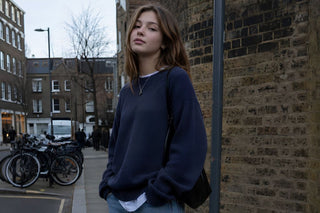
There's a scene most people remember from the original Devil Wears Prada. Miranda Priestly explains to Andy, who's just laughed at a choice between two nearly identical blue belts, that the cerulean sweater she's wearing, the colour she casually calls cerulean, trickled down from couture shows through department stores and eventually landed in a discount bin. She didn't choose her jumper. Fashion chose it for her. Whether she knew it or not.
That cerulean sweater scene has stayed in people's heads for nearly twenty years. The sequel's in cinemas now, and it's already generated the same kind of conversation, about the outfits, about the characters, about what the clothes in this film are actually saying and whether any of it translates into real life.
The answer is yes. But not in the way a shopping guide would tell you. Here's what the Devil Wears Prada 2 outfits are actually about, and what's worth taking from them.
Miranda Priestly's outfits: nothing left to chance
Miranda Priestly has one of the most recognisable aesthetics in cinema. White hair. Immaculate tailoring. Shoes that were selected, not grabbed. Everything she wears says the same thing: I'm not here to be comfortable. I'm here to be certain.
That's a choice, even when it looks like inevitability. And it's a choice a lot of people find genuinely fascinating, the idea that what you wear can be a kind of shield, a signal, a way of walking into a room already decided.
It's not a style that works for everyone, and it's not supposed to. The point of Miranda's aesthetic is that it belongs entirely to her. Nobody else could carry it the same way. That's what the sequel explores -- what happens when the certainty starts to cost something.
Andy's outfits: dressing for yourself
Andy's outfits in both films tell the most interesting story because they change. In the original, the transformation is visible and deliberate; she goes from the cerulean sweater she didn't choose to looks that are precise and intentional. In the sequel, she's spent years away from that world, and the question her wardrobe's quietly asking is: who are you when nobody's watching?
The Andy outfits in DWP2 are softer than you might expect. Less constructed. More like someone who's worked out what she actually likes rather than what she's supposed to like. Relaxed tailoring. Good basics worn properly. Nothing that tries too hard. The sequel's costume designer has said in interviews that Andy's wardrobe in this film is about a woman who's stopped performing and started choosing.
That's the one that translates most directly into a real wardrobe. A well-cut trouser, a linen top that fits properly, a shoe that anchors the look without competing with it. The whole thing works because every piece was chosen, not grabbed.
Emily's outfits: when you just know
Emily Blunt's Emily is the most honest character in the original film, in a way that tends to go unnoticed. She never claims to be doing the job for any reason other than the true one: she loves fashion, she's good at this, and she wants to be taken seriously in a world that isn't always interested in taking her seriously.
There's something clarifying about that. Not everyone who cares about what they wear is shallow. Not every ambition needs to be wrapped in a higher purpose to be legitimate. Emily wanted the job, she worked for the job, and she was good at the job. The sequel gives her more to do, and she's, by most accounts, the best thing in it.
Her aesthetic has always been sharp, precise, and intentional. She knows exactly what she's going for and she goes for it on purpose. That's not a flaw. That's a skill.
What's changed since the original Devil Wears Prada
The sequel's set in 2026, and the fashion industry it depicts isn't the one from twenty years ago. Print media is struggling. The old hierarchies are shifting. The people who used to decide what was fashionable don't have the same grip on that decision anymore.
Which means, in a quiet way, the film's about what happens when the gatekeepers lose some of their power. And one of the things that happens is that the definition of what counts as fashion gets a little wider. A little more honest. A little less dependent on whether your size is stocked in the right places.
That shift isn't complete. It isn't even close to complete, as anyone who's spent time looking for shoes when their size is not stocked on the high street will tell you. But it is happening. And films like this one, which draw massive audiences and generate real cultural conversation, are part of what makes it visible.
Devil Wears Prada 2 outfit ideas: three looks worth actually trying
The outfits in DWP2 aren't really about the specific pieces; they're about what each woman has decided about herself. But there are three looks the film opens up that translate directly into a real wardrobe, and they're worth thinking about separately.
The Andy look
Relaxed but considered. The key is that nothing's careless, it just looks that way. A well-cut pair of trousers or straight-leg jeans. A linen or cotton top that fits properly across the shoulders. A flat or low shoe that you chose because you love it, not because it goes with everything.
This is the most wearable look for most people because it doesn't require a specific body type, a specific budget, or a specific occasion. It just requires knowing what you actually like rather than what you're supposed to like. The shoe is the tell; it should look like it was chosen last, not first.
It also turns out that shoes that come in your actual size make this look significantly easier to pull off. When the fit's right, the whole outfit reads differently, more deliberate, more like a choice. Maévie was built specifically for the gap where teen sizing ends, and this kind of considered dressing begins. The Andy look is exactly what that gap was designed for.
The Miranda look
Sharp, precise, nothing accidental. The cerulean speech is the key to understanding Miranda's whole wardrobe, she knows exactly where every choice came from and she uses that knowledge intentionally. Tailored trousers, a structured top, a heel or a flat that's clearly the right choice rather than a convenient one. Monochrome or near-monochrome. The SS26 literary chic trend that ran through Celine and Chanel this season is exactly this energy.
This look requires commitment. It doesn't work halfway. If one element is careless, the whole thing reads as trying too hard rather than not trying at all. The shoe needs to be specific, not decorative, not an afterthought, but the piece that makes the precision legible.
The Emily look
Knows exactly what she's doing and does it on purpose. Something with a clear point of view, a colour, a silhouette, a shoe that is the whole statement. Emily Blunt's wardrobe in the sequel has generated more conversation than any other character's because it feels the most owned. It's not trying to be wearable. It's trying to be right, for her, on that day, in that room.
The SS26 retro floral trend and the two-tone sandal moment both live here. The outfit earns the shoe or the shoe earns the outfit; either way, one element is the anchor, and everything else defers to it.
The gap the fashion industry still hasn't filled
For all the conversation the original Devil Wears Prada generated about fashion, about who gets to participate, what it costs, what it means, there's a version of that conversation that almost never happens on screen.
What about the girl who goes shopping and the right shoes don't come in her size? What about the version of Andy's transformation montage where half the options simply don't exist because the high street stops before her size begins?
That's not a niche problem. It's one of the most common and least-discussed gaps in fashion, the years between children's sizing ending and adult styling fitting properly, when the options quietly disappear, and nobody in the industry seems particularly bothered. Maévie was built specifically because that gap exists, and nobody had filled it.
The film's worth seeing. The conversation around it is worth having. And while you're thinking about style, what it means, and what you actually want to wear, it's worth knowing that the options are wider than the high street tends to suggest.
FAQ: Devil Wears Prada 2 outfits
Q What are the outfits in Devil Wears Prada 2?
The sequel features three distinct wardrobe worlds: Miranda's sharp, immaculate tailoring, Andy's relaxed and considered approach, and Emily's precise, point-of-view-led style. The costume design draws heavily on SS26 trends, including literary chic tailoring, linen basics, and statement shoes. Each character's wardrobe tells a story about her relationship with fashion rather than just her taste.
Q What are Andy's outfits in Devil Wears Prada 2?
A Andy's outfits in the sequel are softer and more personal than her DWP1 transformation looks. The costume designer has described them as the wardrobe of a woman who has stopped performing and started choosing: relaxed tailoring, well-fitting basics, and shoes that feel selected rather than grabbed. It's the most wearable look in the film and the one that translates most directly into real life.
Q What is the cerulean sweater in Devil Wears Prada 2?
A The cerulean sweater is one of the most referenced moments from the original film, Miranda's speech explaining how the colour Andy dismissed as "just a blue jumper" had trickled down from couture. The sequel references this moment, and searches for the cerulean sweater have spiked since the film's release as audiences reconnect with the original's most famous fashion scene.
Q Who is the costume designer for Devil Wears Prada 2?
A The costume design for DWP2 has been widely discussed since the film's release, with particular attention paid to the contrast between the three central characters' wardrobes. Details on the specific designer are covered extensively in fashion press since the trailer's release and in the film's production notes.
Q What outfit ideas are inspired by Devil Wears Prada 2?
A Three looks are worth trying. The Andy look: relaxed tailoring, linen basics, a shoe you chose because you love it. The Miranda look: sharp, monochrome, nothing accidental. The Emily look: one strong point of view, a colour or a shoe, and everything else in service of it. The three characters offer genuinely different templates rather than variations on the same aesthetic.
Q What should I wear to see Devil Wears Prada 2?
A Whatever you actually want to wear. The film is, at its core, about the difference between dressing to be seen and dressing to feel like yourself. The most interesting version is when they're the same thing. If you want a starting point: the Andy look, something considered, something that fits properly, a shoe that was chosen rather than grabbed, works for almost any setting.